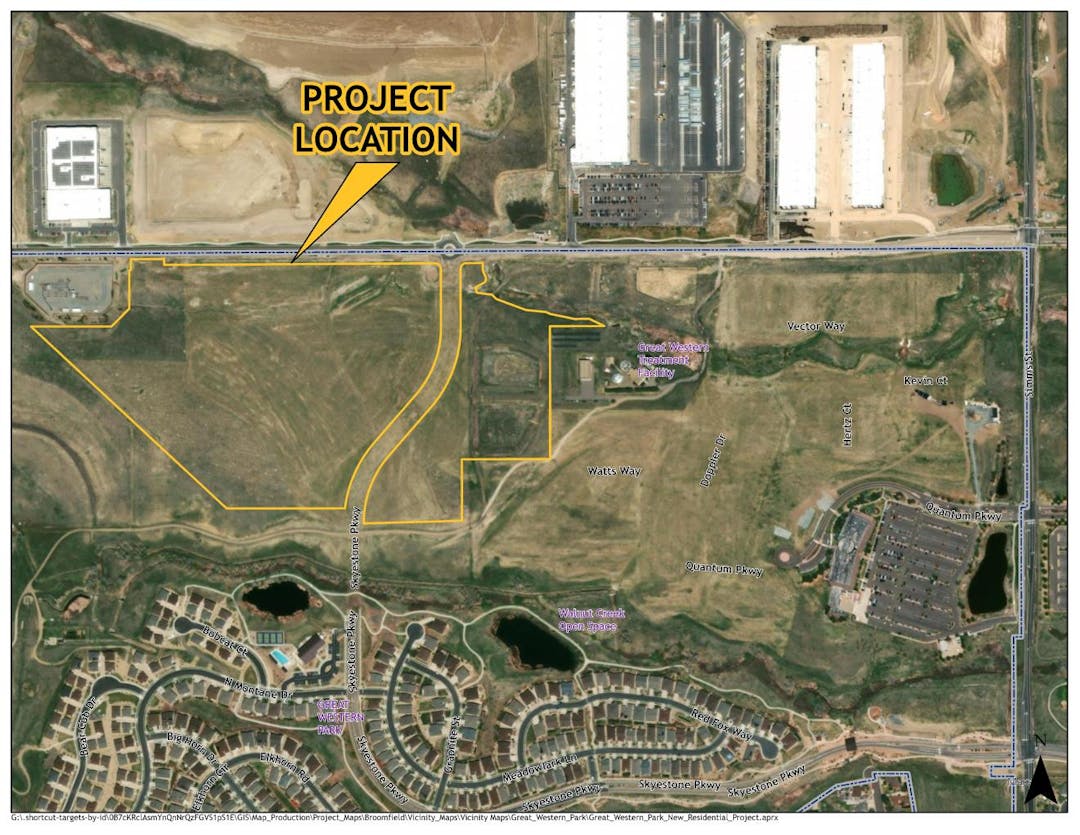
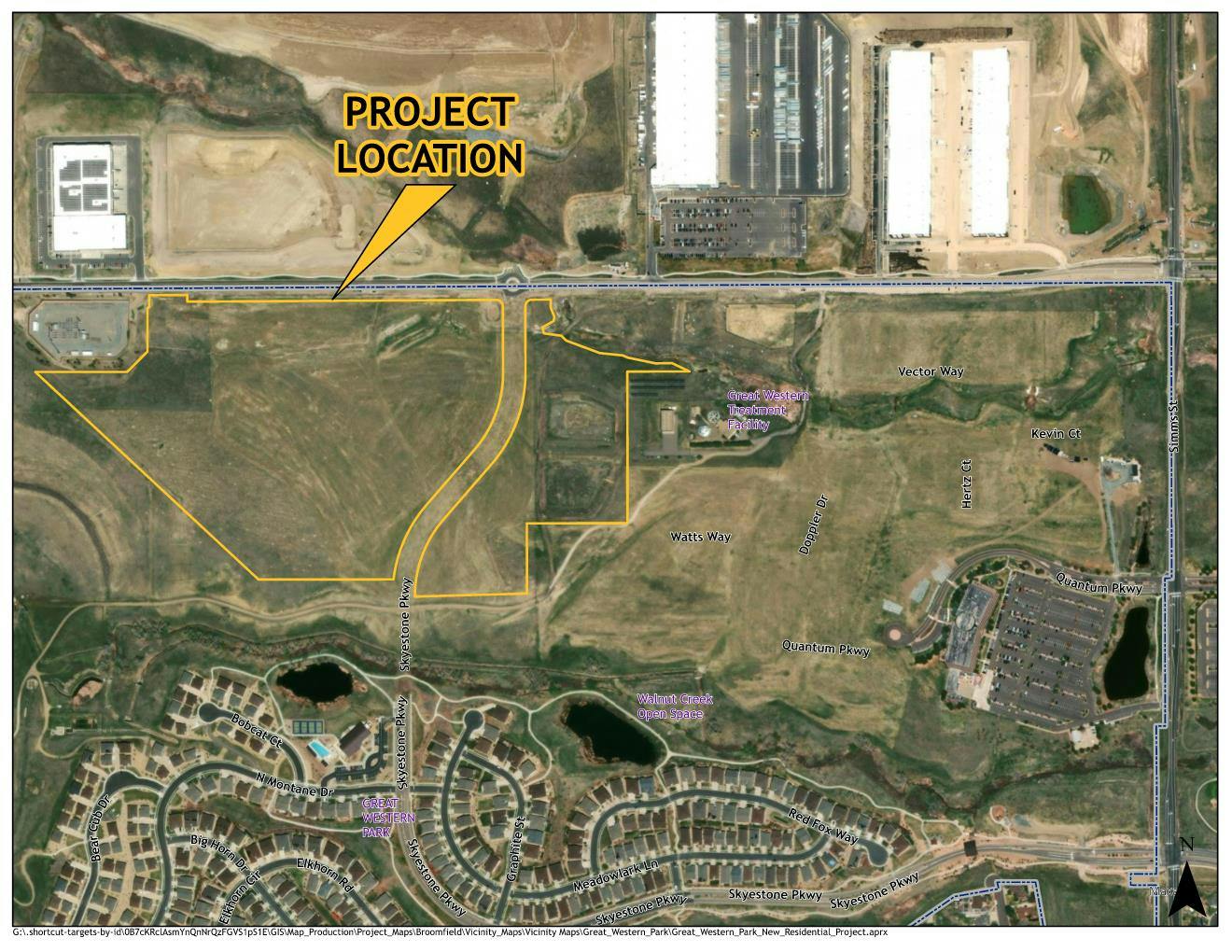
Share • The Great Western Park PUD Amendment would permit construction of up to 820 residential units. What percentage of anticipated new housing construction in Broomfield over the next five years would this represent?
• Would affordable housing requirements apply to this development? If so, how many units would be designated for affordable housing?
• Approximately how many housing units could be constructed on undeveloped land throughout Broomfield that is currently zoned residential?
• The most recent comprehensive plan on broomfield.org is from 2016. How can a fast-growing community like Broomfield adequately consider rezoning when its development plan is nearly 10 years old?
• The proposed development to house what could be more than 2,000 new residents is distant from any public transportation options. How does this fit within Broomfield’s development policies?
• Development on Tract N-3 is envisioned to be a maximum density of 15 units per acre. That is a lot size of 2,904 square feet, far smaller than lot sizes in the neighboring Skyestone. Is that a reasonable density for single-family/duplex homes? If density were lower, would the developer determine the project to be financially unfeasible?
• The project plan does not appear to include any commitment to extend Skyestone Parkway north of 112th Avenue to the reconfigured Simms Street. Shouldn’t this be a condition for approval to alleviate southbound traffic on Skyestone Parkway or eastbound traffic on 112th??
• While the description says “public land dedication will be calculated at the time of [a] future site development plan,” how can neighbors make an evaluation of whether the project is in the public interest without this information?
• The description says “If this project moves forward after concept review, a traffic study and street design will be considered to ensure cut-through traffic [on Skyestone Parkway] is not encouraged.” What assurance can be given to Skyestone residents that (1) such study and street design in fact will be conducted, not just “considered,” and (2) the developer would be required to follow any conditions?
• The description says conversion of commercial to residential zoning “is anticipated to have a negative financial impact” but that impact has not yet been calculated. Drawing from other development in Broomfield, what are generalized estimates for property tax revenue for (a) residential development, (b) commercially zoned undeveloped land, and (c) commercially zoned developed property?
• If the change in zoning is found to have a negative financial impact, on what grounds would Broomfield still approve the project?
• While the description notes potential sound issues from a nearby firing range, it does not assess sound impacts from constant overhead flight school air traffic from Rocky Mountain Metropolitan Airport, which is currently conducting a Part 150 Noise Study. Why is this issue not noted?
• The notice does not discuss impact on infrastructure such as water supply, which is at the physical tail end of Broomfield’s system. Would there be an impact on water pressure in other nearby neighborhoods such as Skyestone? If expansion of water supply infrastructure is needed, who would pay for that – the Great Western Park PUD, or all of Broomfield?
on Facebook
Share • The Great Western Park PUD Amendment would permit construction of up to 820 residential units. What percentage of anticipated new housing construction in Broomfield over the next five years would this represent?
• Would affordable housing requirements apply to this development? If so, how many units would be designated for affordable housing?
• Approximately how many housing units could be constructed on undeveloped land throughout Broomfield that is currently zoned residential?
• The most recent comprehensive plan on broomfield.org is from 2016. How can a fast-growing community like Broomfield adequately consider rezoning when its development plan is nearly 10 years old?
• The proposed development to house what could be more than 2,000 new residents is distant from any public transportation options. How does this fit within Broomfield’s development policies?
• Development on Tract N-3 is envisioned to be a maximum density of 15 units per acre. That is a lot size of 2,904 square feet, far smaller than lot sizes in the neighboring Skyestone. Is that a reasonable density for single-family/duplex homes? If density were lower, would the developer determine the project to be financially unfeasible?
• The project plan does not appear to include any commitment to extend Skyestone Parkway north of 112th Avenue to the reconfigured Simms Street. Shouldn’t this be a condition for approval to alleviate southbound traffic on Skyestone Parkway or eastbound traffic on 112th??
• While the description says “public land dedication will be calculated at the time of [a] future site development plan,” how can neighbors make an evaluation of whether the project is in the public interest without this information?
• The description says “If this project moves forward after concept review, a traffic study and street design will be considered to ensure cut-through traffic [on Skyestone Parkway] is not encouraged.” What assurance can be given to Skyestone residents that (1) such study and street design in fact will be conducted, not just “considered,” and (2) the developer would be required to follow any conditions?
• The description says conversion of commercial to residential zoning “is anticipated to have a negative financial impact” but that impact has not yet been calculated. Drawing from other development in Broomfield, what are generalized estimates for property tax revenue for (a) residential development, (b) commercially zoned undeveloped land, and (c) commercially zoned developed property?
• If the change in zoning is found to have a negative financial impact, on what grounds would Broomfield still approve the project?
• While the description notes potential sound issues from a nearby firing range, it does not assess sound impacts from constant overhead flight school air traffic from Rocky Mountain Metropolitan Airport, which is currently conducting a Part 150 Noise Study. Why is this issue not noted?
• The notice does not discuss impact on infrastructure such as water supply, which is at the physical tail end of Broomfield’s system. Would there be an impact on water pressure in other nearby neighborhoods such as Skyestone? If expansion of water supply infrastructure is needed, who would pay for that – the Great Western Park PUD, or all of Broomfield?
on X (formerly Twitter)
Share • The Great Western Park PUD Amendment would permit construction of up to 820 residential units. What percentage of anticipated new housing construction in Broomfield over the next five years would this represent?
• Would affordable housing requirements apply to this development? If so, how many units would be designated for affordable housing?
• Approximately how many housing units could be constructed on undeveloped land throughout Broomfield that is currently zoned residential?
• The most recent comprehensive plan on broomfield.org is from 2016. How can a fast-growing community like Broomfield adequately consider rezoning when its development plan is nearly 10 years old?
• The proposed development to house what could be more than 2,000 new residents is distant from any public transportation options. How does this fit within Broomfield’s development policies?
• Development on Tract N-3 is envisioned to be a maximum density of 15 units per acre. That is a lot size of 2,904 square feet, far smaller than lot sizes in the neighboring Skyestone. Is that a reasonable density for single-family/duplex homes? If density were lower, would the developer determine the project to be financially unfeasible?
• The project plan does not appear to include any commitment to extend Skyestone Parkway north of 112th Avenue to the reconfigured Simms Street. Shouldn’t this be a condition for approval to alleviate southbound traffic on Skyestone Parkway or eastbound traffic on 112th??
• While the description says “public land dedication will be calculated at the time of [a] future site development plan,” how can neighbors make an evaluation of whether the project is in the public interest without this information?
• The description says “If this project moves forward after concept review, a traffic study and street design will be considered to ensure cut-through traffic [on Skyestone Parkway] is not encouraged.” What assurance can be given to Skyestone residents that (1) such study and street design in fact will be conducted, not just “considered,” and (2) the developer would be required to follow any conditions?
• The description says conversion of commercial to residential zoning “is anticipated to have a negative financial impact” but that impact has not yet been calculated. Drawing from other development in Broomfield, what are generalized estimates for property tax revenue for (a) residential development, (b) commercially zoned undeveloped land, and (c) commercially zoned developed property?
• If the change in zoning is found to have a negative financial impact, on what grounds would Broomfield still approve the project?
• While the description notes potential sound issues from a nearby firing range, it does not assess sound impacts from constant overhead flight school air traffic from Rocky Mountain Metropolitan Airport, which is currently conducting a Part 150 Noise Study. Why is this issue not noted?
• The notice does not discuss impact on infrastructure such as water supply, which is at the physical tail end of Broomfield’s system. Would there be an impact on water pressure in other nearby neighborhoods such as Skyestone? If expansion of water supply infrastructure is needed, who would pay for that – the Great Western Park PUD, or all of Broomfield?
on Linkedin
Email • The Great Western Park PUD Amendment would permit construction of up to 820 residential units. What percentage of anticipated new housing construction in Broomfield over the next five years would this represent?
• Would affordable housing requirements apply to this development? If so, how many units would be designated for affordable housing?
• Approximately how many housing units could be constructed on undeveloped land throughout Broomfield that is currently zoned residential?
• The most recent comprehensive plan on broomfield.org is from 2016. How can a fast-growing community like Broomfield adequately consider rezoning when its development plan is nearly 10 years old?
• The proposed development to house what could be more than 2,000 new residents is distant from any public transportation options. How does this fit within Broomfield’s development policies?
• Development on Tract N-3 is envisioned to be a maximum density of 15 units per acre. That is a lot size of 2,904 square feet, far smaller than lot sizes in the neighboring Skyestone. Is that a reasonable density for single-family/duplex homes? If density were lower, would the developer determine the project to be financially unfeasible?
• The project plan does not appear to include any commitment to extend Skyestone Parkway north of 112th Avenue to the reconfigured Simms Street. Shouldn’t this be a condition for approval to alleviate southbound traffic on Skyestone Parkway or eastbound traffic on 112th??
• While the description says “public land dedication will be calculated at the time of [a] future site development plan,” how can neighbors make an evaluation of whether the project is in the public interest without this information?
• The description says “If this project moves forward after concept review, a traffic study and street design will be considered to ensure cut-through traffic [on Skyestone Parkway] is not encouraged.” What assurance can be given to Skyestone residents that (1) such study and street design in fact will be conducted, not just “considered,” and (2) the developer would be required to follow any conditions?
• The description says conversion of commercial to residential zoning “is anticipated to have a negative financial impact” but that impact has not yet been calculated. Drawing from other development in Broomfield, what are generalized estimates for property tax revenue for (a) residential development, (b) commercially zoned undeveloped land, and (c) commercially zoned developed property?
• If the change in zoning is found to have a negative financial impact, on what grounds would Broomfield still approve the project?
• While the description notes potential sound issues from a nearby firing range, it does not assess sound impacts from constant overhead flight school air traffic from Rocky Mountain Metropolitan Airport, which is currently conducting a Part 150 Noise Study. Why is this issue not noted?
• The notice does not discuss impact on infrastructure such as water supply, which is at the physical tail end of Broomfield’s system. Would there be an impact on water pressure in other nearby neighborhoods such as Skyestone? If expansion of water supply infrastructure is needed, who would pay for that – the Great Western Park PUD, or all of Broomfield?
link
• The Great Western Park PUD Amendment would permit construction of up to 820 residential units. What percentage of anticipated new housing construction in Broomfield over the next five years would this represent?
• Would affordable housing requirements apply to this development? If so, how many units would be designated for affordable housing?
• Approximately how many housing units could be constructed on undeveloped land throughout Broomfield that is currently zoned residential?
• The most recent comprehensive plan on broomfield.org is from 2016. How can a fast-growing community like Broomfield adequately consider rezoning when its development plan is nearly 10 years old?
• The proposed development to house what could be more than 2,000 new residents is distant from any public transportation options. How does this fit within Broomfield’s development policies?
• Development on Tract N-3 is envisioned to be a maximum density of 15 units per acre. That is a lot size of 2,904 square feet, far smaller than lot sizes in the neighboring Skyestone. Is that a reasonable density for single-family/duplex homes? If density were lower, would the developer determine the project to be financially unfeasible?
• The project plan does not appear to include any commitment to extend Skyestone Parkway north of 112th Avenue to the reconfigured Simms Street. Shouldn’t this be a condition for approval to alleviate southbound traffic on Skyestone Parkway or eastbound traffic on 112th??
• While the description says “public land dedication will be calculated at the time of [a] future site development plan,” how can neighbors make an evaluation of whether the project is in the public interest without this information?
• The description says “If this project moves forward after concept review, a traffic study and street design will be considered to ensure cut-through traffic [on Skyestone Parkway] is not encouraged.” What assurance can be given to Skyestone residents that (1) such study and street design in fact will be conducted, not just “considered,” and (2) the developer would be required to follow any conditions?
• The description says conversion of commercial to residential zoning “is anticipated to have a negative financial impact” but that impact has not yet been calculated. Drawing from other development in Broomfield, what are generalized estimates for property tax revenue for (a) residential development, (b) commercially zoned undeveloped land, and (c) commercially zoned developed property?
• If the change in zoning is found to have a negative financial impact, on what grounds would Broomfield still approve the project?
• While the description notes potential sound issues from a nearby firing range, it does not assess sound impacts from constant overhead flight school air traffic from Rocky Mountain Metropolitan Airport, which is currently conducting a Part 150 Noise Study. Why is this issue not noted?
• The notice does not discuss impact on infrastructure such as water supply, which is at the physical tail end of Broomfield’s system. Would there be an impact on water pressure in other nearby neighborhoods such as Skyestone? If expansion of water supply infrastructure is needed, who would pay for that – the Great Western Park PUD, or all of Broomfield?
Foster
asked
about 1 year ago
Thank you for your questions. Please find responses below in bold:
- The Great Western Park PUD Amendment would permit construction of up to 820 residential units. What percentage of anticipated new housing construction in Broomfield over the next five years would this represent?
Broomfield currently projects 6,448 new residential units between 2025 and 2030. Most of these units belong to projects that already have approvals, meaning their development can proceed within this timeframe or later. This figure is a projection and may be lower or higher depending on new applications and market conditions.
This development application introduces up to 820 additional units, which are not included in the current projections. These units would represent an approximately 12.7% increase over the current projected units.
Would affordable housing requirements apply to this development? If so, how many units would be designated for affordable housing?
Yes, Broomfield’s Inclusionary Housing Ordinance (IHO) applies to all new residential developments. Affordable housing unit requirements are based on the number of units approved in a Site Development Plan, which is a later step in the process if the project moves forward. The requirements state that 12% of single-unit/duplex for-sale units must be affordable at 100% of the Area Median Income, and 20% of multi-unit rental developments must be affordable at 60% of the Area Median Income.
Based on the concept review information, a preliminary estimate of IHO units based on maximum potential densities is as follows:
Approximately how many housing units could be constructed on undeveloped land throughout Broomfield that is currently zoned residential?
Because vacant residential land is comprised of multiple different zoning districts (including Planned Unit Development - which is customized zoning), and densities can vary based on the type of residential unit (single-unit, duplex, townhome, or apartment) it isn’t possible to calculate the total number of housing units that could be constructed on the vacant land in the entire City and County.
The most recent comprehensive plan on broomfield.org is from 2016. How can a fast-growing community like Broomfield adequately consider rezoning when its development plan is nearly 10 years old?
Comprehensive Plans are designed to be long-range planning documents (typically with a 20-25 year planning horizon). Historically, Broomfield has updated its Comprehensive Plan approximately every decade, and a comprehensive plan update can take two or more years to complete. Broomfield is beginning the process to update the Comprehensive Plan, but does not anticipate that process to begin until 2026. That being said, rezonings are not solely based upon the Comprehensive Plan. Below is an excerpt from the Municipal Code regarding rezoning requests and decisions made by City Council regarding those requests.
The recommendation of the land use review commission and decision of the city council for rezoning requests shall consider the applicant's proposed rezoning request based upon the following criteria:
(1)The proposal is in (i) general conformance with applicable land use plans including but not limited to the Broomfield Comprehensive Plan and, sub area plans, or (ii) there has been substantial change in the character of the area to support the rezoning action, or (iii) the official zoning classification is in error.
(2)The proposal is compatible with existing and allowable land uses in the surrounding area.
(3)The proposal's effect upon the health, safety, and welfare of the residents and landowners in the surrounding areas.
(4)The proposal is an opportunity or an appropriate site, at an appropriate location, for the particular type of land use or development proposed and will help the city achieve a balance of land use, tax base, or housing types consistent with the city's overall planning and economic development goals.
The proposed development to house what could be more than 2,000 new residents is distant from any public transportation options. How does this fit within Broomfield’s development policies?
Accessibility to public transportation is not a review criteria for development applications. While proximity to transit is a positive factor for new development, there is very limited public transit provided to Broomfield by RTD.
Development on Tract N-3 is envisioned to be a maximum density of 15 units per acre. That is a lot size of 2,904 square feet, far smaller than lot sizes in the neighboring Skyestone. Is that a reasonable density for single-family/duplex homes?
The lot size identified in this question assumes that the developer moves forward with their maximum density, the lot sizes may ultimately vary based on the final site design in the future site development plan and final plat. Broomfield has seen single-unit and duplex developments with comparable lot sizes approved through other developments recently. At Council’s direction, the Planning Division is also bringing forward a proposed ordinance to modify the development standards for medium-low density (R-3), which would establish a minimum lot size of 1,125 SF for single-unit and duplex lots. The intent of this ordinance is to create more zoning options for missing middle housing in Broomfield. Missing middle housing includes smaller homes and/or duplexes and townhomes, which can provide a more attainable housing option. This ordinance is anticipated to be considered for adoption by City Council later this summer.
If density were lower, would the developer determine the project to be financially unfeasible?
We’re unable to speak to the developer’s pro forma and financial analysis on what is feasible or unfeasible for the development if densities were to decrease.
The project plan does not appear to include any commitment to extend Skyestone Parkway north of 112th Avenue to the reconfigured Simms Street. Shouldn’t this be a condition for approval to alleviate southbound traffic on Skyestone Parkway or eastbound traffic on 112th??
The land on the north side of W 112th is located in Jefferson County. Jefferson County has approved development on these properties in accordance with their 2018 Major Thoroughfare Plan, which does not show Skyestone Parkway connecting to Simms Street north of W 112th Ave.
While the description says “public land dedication will be calculated at the time of [a] future site development plan,” how can neighbors make an evaluation of whether the project is in the public interest without this information?
Public Land Dedication is required at a rate of 24 acres per 1,000 residents generated by a development. Once calculated, there are a variety of methods for meeting the dedication obligation, which typically include a partial on-site dedication and a partial cash-in-lieu. Other methods, or a combination of methods, may also be proposed. These details are typically established once the applicant has filed a development application that specifies the number and type of units, including the details regarding income-aligned units. At this time, the applicant is proposing to satisfy their future public land dedication through a combination of existing surplus within the Great Western Park PUD, additional on-site dedications with this new development, and cash-in-lieu payments.
The description says “If this project moves forward after concept review, a traffic study and street design will be considered to ensure cut-through traffic [on Skyestone Parkway] is not encouraged.” What assurance can be given to Skyestone residents that (1) such study and street design in fact will be conducted, not just “considered,” and (2) the developer would be required to follow any conditions?
A traffic study is required as part of formal development applications, and the future application will not be reviewed without one. Concerning Skyestone Parkway, the City and County of Broomfield’s traffic engineer will work with the entity (either the Metro District or private developer) on the Skyestone Parkway design. This could include elements that discourage excessive speeding and cut through traffic, such as neckdowns, traffic circles, or speed tables. If these elements are incorporated into the construction drawings for the street design, they will be required to be installed. Traffic calming devices are not required per Broomfield’s Standards or Code, although they can be encouraged by staff.
The description says conversion of commercial to residential zoning “is anticipated to have a negative financial impact” but that impact has not yet been calculated. Drawing from other development in Broomfield, what are generalized estimates for property tax revenue for (a) residential development, (b) commercially zoned undeveloped land, and (c) commercially zoned developed property?
It's not possible to offer generalized property tax outcomes for Broomfield because of the complex factors involved, such as determining property values from preliminary development plans, the mix of potential commercial uses and residential housing types, and location-specific mill levies. Additionally, when Broomfield staff does this type of analysis, we incorporate financial factors to estimate the cost of services resulting from the types of development to calculate an estimated fiscal impact.
Broomfield staff will be completing a fiscal analysis as part of our review of a proposed development, which will be included in the concept review staff memorandum. As you would expect, this analysis is specific to the proposed development and the degree of detail provided for the review and decision. I'd suggest the LRFP Update (2021) as a reference for the information and analysis.
If the change in zoning is found to have a negative financial impact, on what grounds would Broomfield still approve the project?
Financial impacts on their own are not a specific review criterion for rezoning requests. As such, negative financial impacts from proposed rezoning requests do not automatically result in a denial of the request. City Council uses the rezoning review criteria to make decisions. The criteria were listed above in response to another question.
While the description notes potential sound issues from a nearby firing range, it does not assess sound impacts from constant overhead flight school air traffic from Rocky Mountain Metropolitan Airport, which is currently conducting a Part 150 Noise Study. Why is this issue not noted?
Proximity to the airport is an element that will be identified for City Council during the concept review meeting. The key issues listed on the project website are based on the initial review of the development proposal at the time of submittal, and as the website notes, any other key issues will be identified in the staff memorandum.
The notice does not discuss impact on infrastructure such as water supply, which is at the physical tail end of Broomfield’s system. Would there be an impact on water pressure in other nearby neighborhoods such as Skyestone?
Broomfield has an adequate water supply for this development, as development has been anticipated in this area. All developments are required to provide a Utility Report and water model for review during the Site Development Plan review process. This model will allow the developer to properly design the onsite system. The developer’s model will also be incorporated into Broomfield’s master water model, so staff can understand what impact, if any, it will have on the overall system in that area.
If expansion of water supply infrastructure is needed, who would pay for that – the Great Western Park PUD, or all of Broomfield?
Any infrastructure improvements required to serve the development are the responsibility of the developer. Moreover, any required upsizing of existing infrastructure that is triggered by increased demand from the property, compared to what was originally anticipated, would be financed and installed by the private developer.
- Branden Roe, Planning Manager